








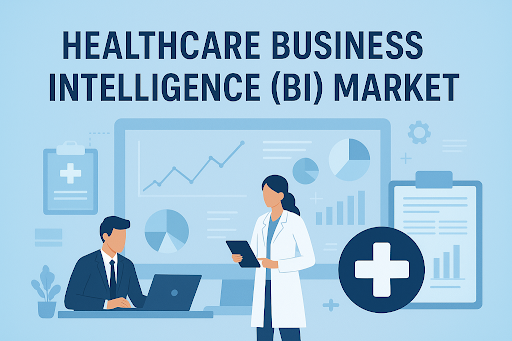
In the high-stakes world of healthcare, the ability to make an informed decision is not just a competitive advantage—it can be a matter of life and death. This imperative is now driving a seismic shift in the industry’s technological backbone, with Healthcare Business Intelligence (BI) emerging as the central nervous system for modern medical organizations. The market, once a niche segment, is now exploding onto the global stage, with recent analysis revealing explosive growth projections that underscore its critical importance.
A new comprehensive market report confirms that The Healthcare Business Intelligence (BI) Market Size was valued at USD 9.0 Billion in 2023, and is expected to reach USD 27.63 Billion by 2032, and grow at a CAGR of 14.0% over the forecast period from 2024 to 2032. This staggering trajectory highlights a fundamental transformation: healthcare is no longer just about treating patients; it’s about intelligently harnessing the vast oceans of data generated every day to improve outcomes, streamline operations, and ensure financial viability.
The Engine Behind the Boom
Several powerful forces are converging to fuel this billion-dollar boom. The global pivot from fee-for-service to value-based care models is perhaps the most significant driver. Under this paradigm, providers are reimbursed based on patient outcomes rather than the volume of services rendered. This requires an unprecedented ability to track, measure, and analyze clinical performance, patient satisfaction, and cost-effectiveness—a task perfectly suited for sophisticated BI platforms.
“Value-based care is fundamentally a data problem,” explains Dr. Anya Sharma, a healthcare analyst at a leading research firm. “You cannot manage what you cannot measure. BI tools are the essential lens that allows hospital systems to see if their treatments are actually working, which physicians are achieving the best outcomes at the lowest cost, and where there are gaps in patient care pathways. It’s moving the industry from intuition-based to evidence-based management.”
Further propelling the market are stringent regulatory requirements, including the push for interoperability and the need to comply with evolving billing and coding standards. Simultaneously, the proliferation of data sources—from Electronic Health Records (EHRs) and wearable devices to genomic sequencing and insurance claims—has created a “data rich but information poor” environment. BI platforms are the key to unlocking actionable insights from this data deluge, enabling predictive analytics for patient readmission risks, optimizing supply chain logistics, and identifying fraudulent insurance claims in real-time.
The Top Players Defining the Competitive Landscape
The Healthcare BI arena is a dynamic and competitive field, populated by a mix of established tech giants, specialized pure-play vendors, and the EHR behemoths who are embedding BI directly into their core platforms.
- The Powerhouses: Microsoft, Oracle, and SAP
These technology titans leverage their vast cloud infrastructure and enterprise reach to offer robust, scalable BI solutions. Microsoft, with its Power BI suite, has made significant inroads by offering user-friendly tools that integrate seamlessly with its Azure cloud and other widely-used productivity software. Its strategy focuses on empowering non-technical “citizen data scientists” within healthcare organizations to create their own reports and dashboards.
Oracle and Siemens Healthineers bring deep industry-specific expertise, offering integrated solutions that combine BI with ERP (Enterprise Resource Planning) and clinical data management systems. Their strength lies in providing a unified view of financial, operational, and clinical data, which is crucial for large, complex hospital networks.
- The Specialists: Domo, Tableau (a Salesforce company), and Qlik
These players are renowned for their best-in-class data visualization and agile analytics capabilities. Tableau, now under the Salesforce umbrella, is a favorite for its intuitive and powerful dashboards that can transform complex clinical and administrative data into easily understandable visual stories. Qlik promotes its associative analytics engine, which allows users to explore data freely across all their sources, uncovering hidden relationships. Domo offers a cloud-native platform that excels in delivering real-time, mobile-first business insights, crucial for executives and managers on the go. - The EHR Integrators: Epic, Cerner (an Oracle company), and Allscripts
Perhaps the most significant competition comes from within. EHR giants like Epic and Cerner have developed their own deeply integrated BI and analytics modules, such as Epic’s Cogito and Cerner’s HealtheIntent. The advantage here is profound: these tools are pre-connected to the patient data, reducing implementation complexity and providing immediate, EHR-contextual insights. With Cerner’s acquisition by Oracle, this space is set for further consolidation and innovation, potentially creating an even more powerful data ecosystem.
Market Segmentation and Future Frontiers
The market’s growth is not uniform across all segments. The predictive analytics component is anticipated to be the fastest-growing, as organizations move beyond descriptive analytics (what happened) to prescriptive and predictive models (what will happen and what should we do about it).
In terms of deployment, the cloud-based model is decisively overtaking on-premise solutions due to its scalability, lower upfront costs, and easier access to advanced AI and machine learning capabilities. Among end-users, the providers segment (hospitals, clinics, physician groups) currently holds the largest market share, driven by needs for clinical analytics, operational efficiency, and financial management. However, the payers segment (insurance companies) is a rapidly growing adopter, using BI for claims analysis, member risk stratification, and combating fraud, waste, and abuse.
The future of Healthcare BI is intrinsically linked to the advancement of Artificial Intelligence (AI) and Machine Learning (ML). The next generation of platforms will move beyond dashboards to offer autonomous insights, natural language queries (“show me the trends in post-surgical infections this quarter”), and AI-driven recommendations for action.
Challenges on the Path to Growth
Despite the optimistic outlook, the path forward is not without obstacles. Data privacy and security remain paramount concerns, especially with sensitive Protected Health Information (PHI). The industry also grapples with significant data siloing; patient information often remains trapped in disparate systems from different vendors, hindering a comprehensive 360-degree view. Furthermore, a skills gap persists, with a shortage of professionals who possess both deep analytical expertise and an understanding of clinical healthcare workflows.
Nevertheless, the momentum is undeniable. As healthcare organizations worldwide confront pressures to do more with less, improve patient satisfaction, and navigate an increasingly complex regulatory landscape, investment in Business Intelligence is no longer a luxury but a strategic imperative. The projected ascent to a $27.63 billion market is a clear testament to the fact that in the new era of healthcare, data is not just an asset—it is the most valuable currency for survival and success.