








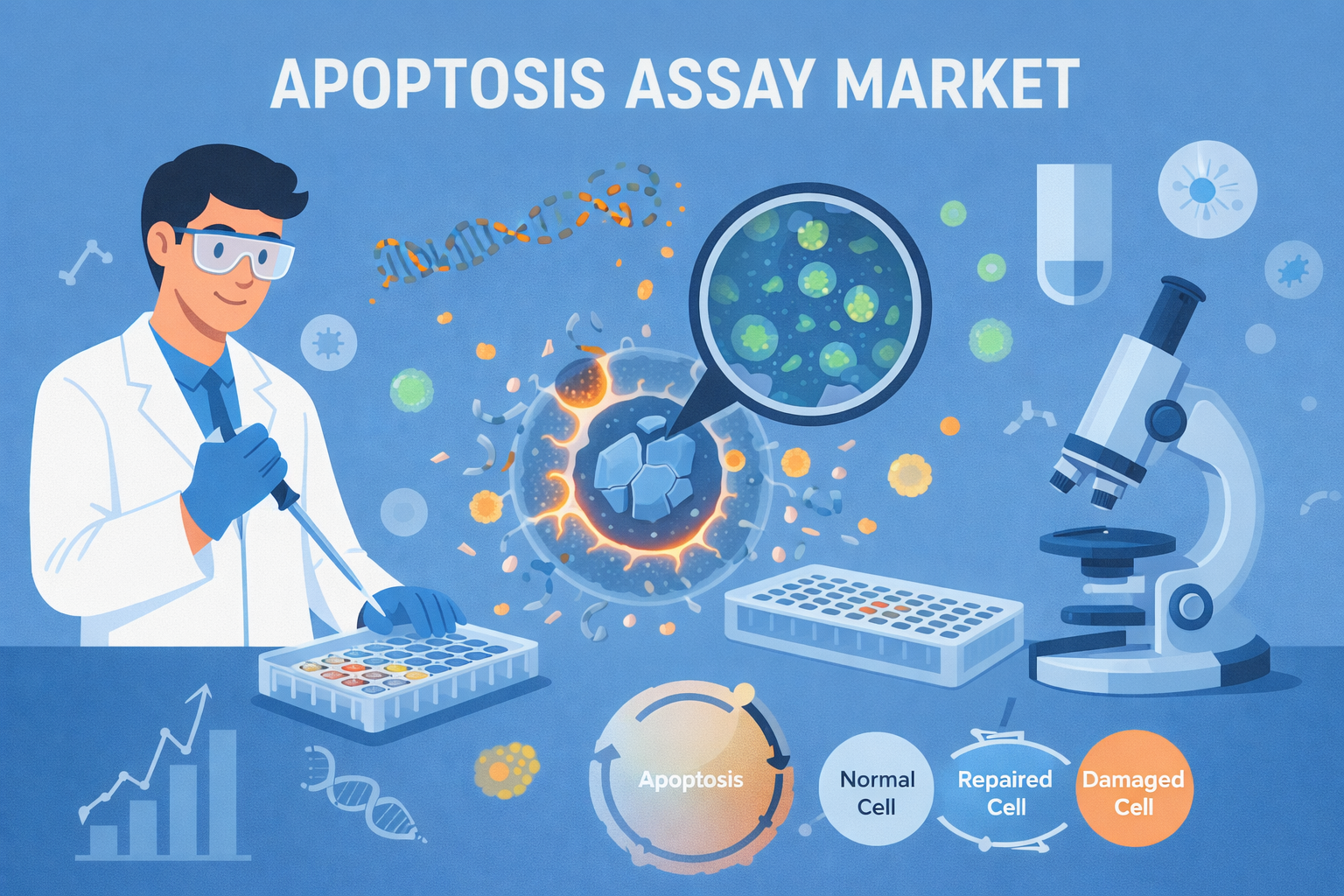
The global life sciences tools sector is witnessing a significant consolidation wave, with the highly specialized apoptosis assay market at its epicenter. Apoptosis, the process of programmed cell death, is a critical biological mechanism and a paramount target for cancer drug development, neurodegenerative disease research, and toxicology studies. As pharmaceutical pipelines become increasingly dominated by therapies designed to either induce or inhibit apoptosis, the demand for sophisticated, high-throughput tools to measure this process has exploded. This demand is now driving a series of strategic mergers and acquisitions (M&A), positioning top players for dominance in a multi-billion dollar growth arena.
The market’s financial potential is staggering. According to SNS Insider, The Apoptosis Assay Market size is estimated at USD 6.90 billion in 2025 and is expected to reach USD 14.13 billion by 2033, growing at a CAGR of 9.37% over 2026-2033. This robust growth is fueled by the relentless pace of oncology R&D, rising investment in biologics and targeted therapies, and the expanding application of apoptosis assays in drug discovery and translational research.
The M&A Imperative: Building Integrated Powerhouses
In response, industry leaders are not just growing organically; they are aggressively acquiring to fill technological gaps, expand their geographical footprint, and offer end-to-end solutions. The traditional model of selling standalone assay kits is evolving into providing integrated platforms that combine reagents, advanced instrumentation, and data analytics software.
The most notable recent transaction was the blockbuster acquisition of Nexcelom Bioscience by PerkinElmer (now Revvity), a deal valued at approximately $260 million. Nexcelom was a leader in automated cell counters and image-based cytometry, including its flagship Celigo Image Cytometer, which provides high-content apoptosis analysis. For Revvity, this move was strategic: it integrated Nexcelom’s strength in live-cell, label-free analysis with its own vast portfolio of detection reagents and high-throughput screening systems, creating a formidable closed-loop solution for oncology and immunology researchers.
Similarly, Bio-Techne Corporation’s acquisition of Asuragen for up to $320 million significantly bolstered its position. While Asuragen brought strong capabilities in molecular diagnostics, its portfolio of apoptosis-related biomarkers and qPCR-based assay technologies perfectly complements Bio-Techne’s protein analysis tools (R&D Systems) and spatial biology platforms. This allows the company to offer a multi-omics approach to studying cell death pathways.
“The M&A activity in this space is a direct reflection of the market’s complexity,” says Dr. Anya Sharma, a senior analyst at LifeSci Capital. “Researchers are no longer satisfied with a simple TUNEL assay. They want multiplexed, kinetic, real-time data on apoptosis within the context of the tumor microenvironment. This requires a confluence of technologies—flow cytometry, high-content imaging, microfluidics, and AI-driven analysis. No single company mastered it all, so consolidation became inevitable.”
Top Players and Their Strategic Posturing
The competitive landscape is now defined by a tier of integrated giants and specialized innovators.
- Market Leaders: Thermo Fisher Scientific, Merck KGaA (Sigma-Aldrich), and Revvity dominate through sheer scale and comprehensive portfolios. Thermo Fisher’s suite, from Attune NxT flow cytometers and Muse cell analyzers to a vast array of antibodies and kits, offers a one-stop-shop. Their strategy hinges on deep integration with their clinical and diagnostic divisions.
- Specialized Powerhouses: Becton, Dickinson and Company (BD) remains a behemoth in flow cytometry, the gold-standard technology for apoptosis detection via Annexin V/PI staining. BD’s continuous innovation in spectral flow and full-spectrum analysis allows for increasingly complex apoptosis phenotyping.
- Pure-Play Innovators: Companies like Sartorius AG (with its Incucyte live-cell analysis systems) and Agilent Technologies (with its xCELLigence RTCA for label-free, real-time monitoring) are winning market share by focusing on kinetic, long-term apoptosis monitoring without cell disturbance—a key demand in drug safety testing.
- Niche Disruptors: Emerging players like Cyntellect (a part of Bio-Techne) with its Celigo, and ChemoMetec with its NucleoCounter systems, continue to push the boundaries of image-based, high-throughput apoptosis analysis, often becoming attractive acquisition targets themselves.
Fueling the Fire: The New Drug Development Engine
The primary engine for this market growth is the pharmaceutical industry’s pipeline. Apoptosis-targeting drugs, such as BCL-2 inhibitors like Venetoclax (AbbVie/Genentech) for leukemia, and novel apoptosis-inducing candidates in solid tumors, require robust companion assays for patient stratification and treatment monitoring. Furthermore, the rise of immuno-oncology has created a need to assess whether immunotherapies are successfully triggering apoptotic pathways in cancer cells.
The burgeoning field of Targeted Protein Degradation (TPD), including PROTACs and molecular glues, also relies heavily on apoptosis assays. These novel therapeutics often work by inducing the degradation of key survival proteins, ultimately leading to cell death. Demonstrating efficient apoptosis induction is a critical proof-of-concept in TPD development.
Challenges and the Road to 2033
Despite the bullish outlook, the market faces hurdles. The high cost of advanced instruments like spectral flow cytometers and high-content imagers can be prohibitive for smaller labs and academic institutions. Furthermore, data standardization and analysis remain complex, creating an opportunity for companies that can seamlessly integrate AI and machine learning into their software platforms.
The path to the projected $14.13 billion market by 2033 will be paved by continuous technological convergence. Future growth will likely be driven by further integration of 3D cell culture (organoid) apoptosis assays, increased use in neurodegenerative disease research for measuring neuronal cell death, and the democratization of complex technologies through benchtop, user-friendly systems.
In conclusion, the apoptosis assay market is undergoing a transformative phase. Strategic M&A is creating vertically-integrated titans capable of serving the entire drug discovery continuum. As the understanding of cell death pathways deepens and therapeutic targeting becomes more precise, the companies that control the tools to measure apoptosis will not only reap significant financial rewards but will also play a pivotal role in accelerating the development of tomorrow’s life-saving medicines. The race is on, and the stakes—both commercially and clinically—have never been higher.