


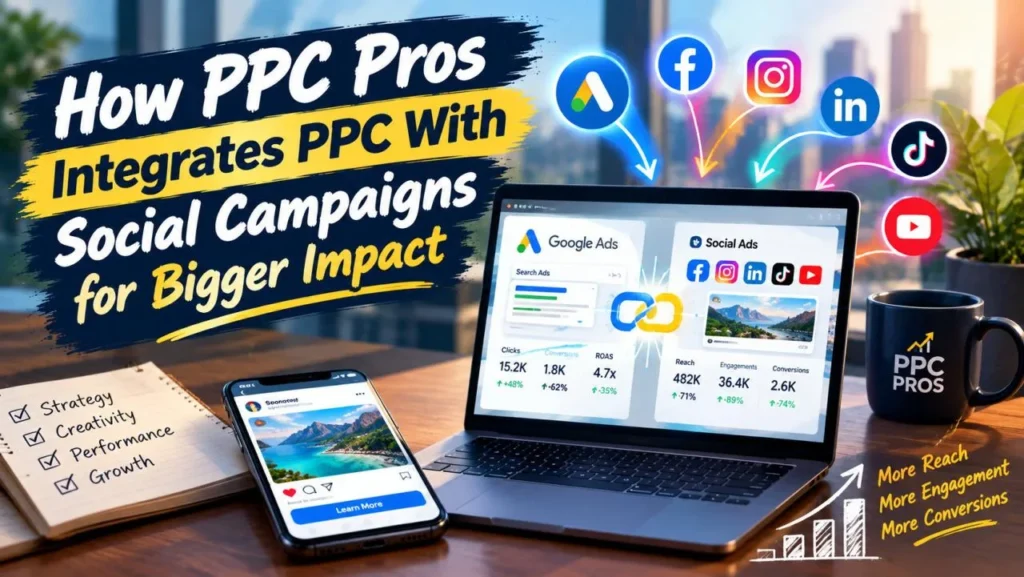
Digital advertising has become increasingly complex as businesses try to reach customers across multiple online platforms. Paid search can capture people who are actively looking for a product or service, while social media campaigns can introduce brands to potential customers who may not yet be ready to buy. When these two approaches work together, businesses can create a more connected advertising strategy.
Pay-per-click advertising and social media advertising are often managed as separate channels. Search campaigns focus on keywords, search intent, and conversions, while social campaigns typically emphasize audience targeting, creative content, engagement, and brand awareness. However, treating them as completely independent strategies can leave opportunities on the table.
Integrating PPC with social campaigns allows businesses to share data, coordinate messaging, and create a more consistent customer journey. Instead of asking whether search or social advertising is better, marketers can use each channel for the role it performs best.
Why PPC and Social Media Work Well Together
Search and social advertising reach people at different points in the buying journey.
Someone searching Google for a specific product or service may already have a strong intention to make a purchase. A search ad can put a relevant business in front of that person at precisely the moment they are looking for a solution.
Social media works differently. Users may not be actively searching for a particular product, but they can still discover a brand through an advertisement, video, image, recommendation, or piece of engaging content.
Combining these channels gives businesses more opportunities to reach potential customers.
A person might first encounter a company through a social media advertisement. Later, they may search for the company’s name or a related service on Google. Another customer might discover a brand through search and subsequently encounter its social content several times before making a purchase.
When advertising channels are connected, marketers can better understand these interactions.
Using Search Data to Improve Social Campaigns
One of the most useful ways to integrate PPC and social advertising is by sharing insights between campaigns.
Search campaigns can reveal what potential customers are actively looking for. Keyword data can provide information about the language people use, the problems they want to solve, and the products or services generating the most interest.
Those insights can influence social advertising.
For example, suppose a company discovers through its PPC campaigns that customers frequently search for a particular feature or benefit. That information can be incorporated into social media advertisements, videos, and other creative assets.
Instead of guessing what messaging might appeal to an audience, marketers can use actual search behavior as one source of information.
The process can work in the opposite direction as well. Social campaigns can reveal which messages, visuals, or audience segments generate strong engagement. Those insights can then help inform search advertising copy and landing page messaging.
Creating Consistent Messaging Across Channels
Customers can encounter a brand in many different places before they make a purchase.
They may see a Facebook advertisement in the morning, search for the company later that day, visit its website, and encounter another advertisement several days afterward.
If every channel communicates a completely different message, the customer experience can become confusing.
Integrated campaigns help create greater consistency.
The wording does not need to be identical across every platform. Social media may use more conversational language, while search ads may need to communicate value quickly because of limited space.
However, the central value proposition, offers, benefits, and brand identity should remain recognizable.
Consistent messaging can help customers understand that the advertisements they encounter across different platforms are connected to the same company and overall campaign.
Retargeting Customers After Their First Interaction
One of the biggest advantages of combining PPC and social campaigns is the ability to reconnect with people who have already interacted with a business.
Not every visitor converts during their first website visit. Someone may click a search advertisement, browse several pages, and leave without making a purchase.
That does not necessarily mean the advertising failed.
The person may need additional information before making a decision. They may want to compare prices, read reviews, discuss the purchase with someone else, or simply return later.
Social retargeting can provide another opportunity to reach that person.
For example, someone who visits a product page after clicking a search advertisement could later encounter a relevant social advertisement. The second interaction can reinforce the product’s benefits or introduce additional information.
This creates a more connected journey instead of treating every advertising interaction as an isolated event.
Combining Audience Insights
Audience data is another area where PPC and social campaigns can complement each other.
Search advertising provides information about intent. Social platforms can provide information about interests, behaviors, demographics, and engagement patterns, depending on the platform and available targeting options.
When marketers analyze these insights together, they can develop a more complete understanding of potential customers.
For instance, PPC data might show that a particular service-related keyword generates strong conversion rates. Social campaign data could reveal that a specific audience segment responds especially well to content related to that service.
These observations can influence future campaigns.
Marketers can adjust budgets, creative concepts, landing pages, targeting, and messaging based on what the combined data suggests.
Testing Creative Ideas Across Platforms
Social media is often a useful environment for testing creative concepts.
Different images, headlines, videos, calls to action, and messages can be tested against specific audiences. The results can provide useful information about which concepts attract attention and encourage interaction.
Some of those ideas can eventually influence PPC campaigns.
For example, a social advertisement might perform particularly well because it highlights a specific customer benefit. Marketers could test a similar benefit-focused message in search advertising to see whether it improves engagement or conversions.
This does not mean that every successful social advertisement will automatically work in search. Each platform has different user behavior and creative requirements.
However, successful concepts can provide valuable ideas for further testing.
Coordinating Campaign Timing
Timing can also make an integrated campaign more effective.
Businesses launching a promotion, new product, event, or seasonal offer can coordinate their search and social campaigns around the same period.
Social media can help generate awareness before a campaign launches. PPC can capture people actively searching for the promotion once interest increases.
During the campaign, both channels can reinforce the same offer while serving different parts of the customer journey.
Afterward, retargeting and follow-up campaigns can continue communicating with people who interacted with the brand.
This coordinated approach can create a stronger sense of continuity than launching unrelated campaigns across different platforms.
Measuring More Than Clicks
One of the challenges of digital advertising is determining which metrics actually matter.
Clicks and impressions can provide useful information, but they do not necessarily indicate whether advertising is producing meaningful business results.
An integrated strategy should consider metrics such as leads, purchases, qualified inquiries, conversion rates, cost per acquisition, and return on advertising spend.
Attribution can also be complicated because customers may interact with multiple advertisements before converting.
A customer might see a social advertisement, later click a PPC ad, return directly to the website, and finally make a purchase. Looking at only the final interaction may overlook the role that earlier advertising played in the customer’s journey.
Using multiple data points can provide a more complete picture.
How PPC Pros Can Bring the Channels Together
Businesses working with experienced digital advertising teams can use a coordinated approach rather than managing every platform independently.
PPC Pros, for example, can incorporate search advertising insights into broader campaign planning by considering how paid search and social media contribute to the same customer journey.
The goal is not simply to run advertisements on more platforms. Adding channels without a strategy can increase spending without necessarily improving results.
Instead, the focus should be on understanding how each channel contributes to the overall campaign.
Search can capture active demand, while social can build awareness, generate interest, reinforce messaging, and bring previous visitors back into the conversation.
When those functions are coordinated, advertising can become more intentional.
Building Landing Pages That Support Both Channels
The connection between PPC and social advertising should continue after someone clicks an advertisement.
Landing pages are an important part of the customer journey. If the advertisement promises a specific benefit or offer, the landing page should make that information easy to find.
A mismatch between an advertisement and its landing page can create confusion and reduce the likelihood of conversion.
For integrated campaigns, businesses should consider whether their landing pages support the messages being used across both search and social platforms.
The visual design can vary depending on the campaign, but the core offer and value proposition should remain clear.
Landing pages should also be mobile-friendly because social media users frequently interact with advertisements on smartphones.
Optimizing Campaigns Over Time
Integration is not a one-time process.
Advertising performance changes as audiences respond to campaigns, competitors adjust their strategies, and platforms evolve.
Marketers should regularly review campaign data and look for opportunities to improve.
A PPC campaign may reveal a new high-performing keyword. A social campaign may identify a particularly effective creative concept. A landing page test may reveal a better way to present an offer.
These insights can be shared across campaigns.
Over time, this creates a continuous feedback loop in which information from one advertising channel helps improve another.
The result is a strategy that becomes increasingly informed by actual campaign performance rather than assumptions.
Common Mistakes to Avoid
One common mistake is running PPC and social campaigns without any communication between the teams or platforms managing them.
Another is using completely different offers or messages across channels without a clear reason.
Businesses can also make the mistake of focusing exclusively on clicks rather than measuring what happens after those clicks.
Finally, trying to use the same creative approach everywhere can limit performance. Each platform has its own audience behavior, format requirements, and strengths.
Integration does not mean making every campaign identical. It means making the campaigns work toward shared objectives while allowing each channel to perform its specific role.
FAQs
What is the difference between PPC and social media advertising?
PPC generally refers to paid advertising where businesses pay when users click an advertisement, particularly in search advertising. Social media advertising takes place on social platforms and can use a variety of objectives, including awareness, engagement, traffic, and conversions.
Why should businesses combine PPC and social campaigns?
Combining the channels can help businesses reach customers at different stages of the buying journey. Search can capture active demand, while social advertising can build awareness and reinforce brand messaging.
Can PPC data improve social media campaigns?
Yes. Search data can reveal useful information about customer interests, search behavior, and the language people use when looking for products or services. These insights can help inform social advertising messages and creative concepts.
Can social media data improve PPC campaigns?
Yes. Social campaigns can provide insights into which messages, visuals, and audience segments generate engagement. These insights can be used as ideas for PPC testing.
Is retargeting useful when combining PPC and social advertising?
Retargeting can help businesses reconnect with people who previously interacted with their website or advertisements. Someone who did not convert after an initial PPC interaction may respond to a relevant social advertisement later.
How do you measure an integrated PPC and social campaign?
Businesses can monitor metrics such as conversions, qualified leads, cost per acquisition, conversion rates, revenue, and return on advertising spend. Looking at multiple touchpoints can also help provide a broader understanding of the customer journey.
Conclusion
Integrating PPC with social campaigns allows businesses to approach digital advertising as a connected strategy rather than a collection of unrelated channels. Search advertising can capture customers who are actively looking for solutions, while social campaigns can introduce brands to new audiences, reinforce messages, and encourage previous visitors to return. By sharing insights, coordinating messaging, testing creative ideas, and measuring meaningful business outcomes, companies can create campaigns that work together throughout the customer journey. The most effective approach is not simply to advertise in more places, but to understand how each channel can contribute to a larger and more consistent marketing strategy.