News
How PPC Pros Improves PPC Campaign Scalability for Growing Brands
By News Items
September 17, 2026
Field Notes
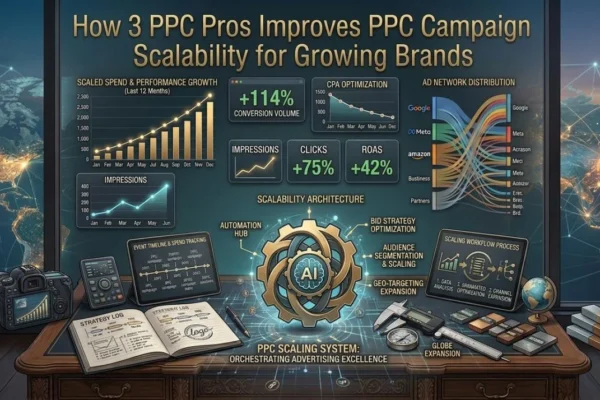
Scaling a paid search and paid social strategy is rarely as simple as increasing daily ad spend. As budgets grow, brands routinely face rising cost-per-acquisition (CPA), audience saturation, inefficient bidding mechanics, and attribution blind spots. Without a structured framework, increasing budget often dilutes ROI instead of driving profitable revenue growth.
Expanding campaign reach while maintaining strict efficiency metrics requires disciplined strategic oversight, reliable technical infrastructure, and robust audience modeling.
The Core Bottlenecks to PPC Scalability
Scaling paid media requires addressing structural account friction. When ad accounts scale without clear frameworks, performance quickly degrades across four key areas:
Budget Scaling ──► Diminishing Returns ──► Audience Burnout ──► Elevated CPA & Wasted Spend
- Audience Overlap & Fatigue: Broadening targeting parameters without negative audience exclusion leads to competing against your own ad sets and burning through high-intent users.
- Conversion Tracking Inefficiencies: Scale requires accurate data signals. Outdated or inaccurate tracking prevents algorithmic bidding models from optimizing effectively.
- Creative Stagnation: Higher ad spend increases impression frequency, causing ad creative to fatigue rapidly without continuous variation and testing.
- Unoptimized Account Structure: Cramming expanded budgets into rigid, outdated campaign architectures leads to poor budget distribution across top-, middle-, and bottom-of-funnel audiences.
How PPC Pros Systematizes Campaign Growth
|
Growth Pillar |
Operational Focus |
Primary Scalability Impact |
|
Comprehensive Account Auditing |
Identifying wasted spend, negative keyword gaps, and tracking errors |
Frees up immediate capital to reinvest into high-performing assets |
|
Full-Funnel Architecture |
Structuring distinct campaigns for Cold Prospects, Mid-Funnel Intent, and Retargeting |
Prevents budget leakage and ensures full audience coverage |
|
Data-Driven Bidding Models |
Leveraging smart bidding strategies paired with strict target ROAS/CPA caps |
Maintains profit margins during rapid ad spend increases |
|
Multi-Channel Expansion |
Scaling search success across Google Ads, Bing, Meta, and LinkedIn |
Diversifies risk and captures net-new demand across ecosystems |
4 Strategic Mechanisms for Scalable Paid Search
Scaling paid media effectively relies on optimizing core account mechanics rather than simply raising daily spend limits.
1. In-Depth Account Audits & Wasted Spend Elimination
Before scaling the budget, the first step is eliminating operational waste. By auditing search query reports, device performance, geographic performance, and match types, non-converting spend is removed. Partnering with an experienced growth agency like PPC Pros allows brands to quickly identify these performance leaks and reallocate existing capital directly into winning ad groups.
2. Full-Funnel Channel Diversification
Relying entirely on high-intent bottom-of-funnel search terms creates an artificial growth ceiling. Scalable accounts expand into mid- and top-of-funnel channels (incorporating YouTube, Google Performance Max, Meta Ads, and Microsoft Advertising) to build brand awareness and continuously replenish the retargeting pool.
3. Rapid Creative & Copy Iteration
At higher spend levels, ad creative fatigues in days rather than weeks. Implementing structured creative testing frameworks (varying headlines, value propositions, visual assets, and calls to action) ensures click-through rates (CTR) remain high and quality scores stay optimized.
4. Continuous Conversion Rate Optimization (CRO)
Driving targeted traffic is only half the equation. As traffic volume increases, custom landing pages optimized for specific search intent ensure that expanded click volume converts into profitable pipeline and sales at scale.
Scaling Roadmap for Growing Brands
|
Phase |
Tactical Execution |
Success Criteria |
|
Phase 1: Foundation (Weeks 1–4) |
Audit tracking, refine match types, eliminate wasted spend, establish baseline CPA |
Clean data pipeline, verified conversion tracking |
|
Phase 2: Consolidation (Weeks 5–8) |
Optimize high-converting campaigns, introduce smart bidding with Target ROAS/CPA caps |
Stable CPA metrics alongside baseline spend |
|
Phase 3: Expansion (Weeks 9–12) |
Launch multi-channel campaigns, introduce broad match + audience signals, scale budget by 15–20% increments |
Increased conversion volume without CPA degradation |
|
Phase 4: Domination (Ongoing) |
Continuous CRO, automated bidding adjustments, systematic creative rotation |
Sustained profitability across scaled budgets |
Pre-Scaling Checklist
Review this essential checklist before significantly increasing your monthly paid media spend.
Technical & Tracking Infrastructure
- [ ] Server-Side Tracking / CAPI: Conversion API or server-side tracking is fully operational to mitigate browser-level data loss.
- [ ] Value-Based Bidding: First-party conversion values are passed back to ad platforms to optimize for revenue rather than pure click volume.
- [ ] Negative Keyword & Audience Lists: Global negative lists and audience exclusions are updated to prevent cross-campaign cannibalization.
Creative & Landing Page Readiness
- [ ] Creative Pipeline: A minimum of 3 to 5 ad variations per ad set are queued for regular rotation.
- [ ] Landing Page Speed & Optimization: Destination pages load quickly on mobile devices and match specific campaign search intent.
- [ ] Budget Pacing Protocols: Clear daily and monthly spend limits are configured to prevent accidental budget overruns.
Frequently Asked Questions
1. How fast should a brand scale its PPC spend?
Budget increases should generally occur incrementally (typically 15% to 20% every few days or week) to allow automated bidding algorithms to adjust without resetting campaign learning phases.
2. Why does CPA increase when spend increases?
As budgets expand, ad platforms move beyond your immediate core audience into broader audience segments with slightly lower purchase intent. Offsetting this requires stronger landing page conversion rates and tailored creative messaging.
3. What is the role of automated bidding in scaling campaigns?
Smart bidding strategies (such as Target CPA and Target ROAS) utilize machine learning to evaluate millions of signals in real time. When paired with accurate conversion data and clear target caps, automated bidding dynamically adjusts bids to maximize return as spend grows.
4. When should a growing brand expand beyond Google Ads?
Brands should consider expanding to secondary channels (like Meta, Microsoft Advertising, or LinkedIn) once core search campaigns have captured the majority of available high-intent search volume or when cost-per-click (CPC) spikes make further vertical scaling inefficient.
Conclusion
Scaling PPC campaigns requires balancing aggressive channel expansion with disciplined account optimization. By auditing existing structures, eliminating wasted ad spend, diversifying channels, and continuously testing creatives, growing brands can scale their paid media spend sustainably while protecting their bottom line.