








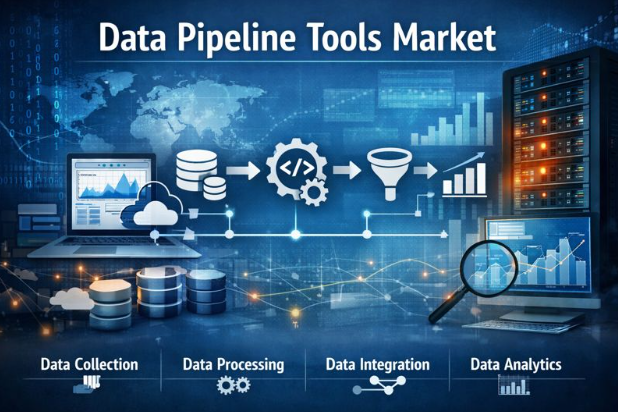
In today’s data-driven economy, organizations are generating information at an unprecedented scale. From transactional records and customer interactions to IoT sensor data and real-time application logs, the volume, velocity, and variety of data have fundamentally changed how businesses operate. At the center of this transformation are data pipeline tools, which have emerged as a critical backbone of modern data engineering practices. These tools are redefining how raw data is collected, processed, moved, and prepared for analytics, artificial intelligence, and decision-making.
Traditionally, data engineering was a highly manual and fragmented discipline. Engineers relied on custom scripts, batch jobs, and tightly coupled systems to move data between sources and destinations. These approaches were often brittle, difficult to scale, and slow to adapt to changing business needs. As organizations expanded their digital footprints, these limitations became more pronounced. Data pipeline tools began to evolve in response, offering structured, automated, and scalable ways to handle complex data workflows across diverse environments.
One of the most significant ways data pipeline tools are transforming data engineering is by enabling automation at scale. Modern pipelines are designed to orchestrate data ingestion, transformation, and delivery with minimal manual intervention. This shift allows data engineers to focus less on repetitive operational tasks and more on designing robust architectures and improving data quality. Automation also reduces human error, ensuring that data flows remain consistent and reliable even as volumes grow exponentially.
Another major transformation lies in the shift from batch-centric processing to real-time and near-real-time data flows. Businesses increasingly require up-to-date insights to remain competitive, whether for fraud detection, personalization, or operational monitoring. Data pipeline tools now support streaming data architectures that process information continuously as it is generated. This capability has redefined data engineering practices, pushing teams to think in terms of event-driven systems rather than static, scheduled jobs.
Data Pipeline Tools Market was valued at USD 13.82 billion in 2025E and is expected to reach USD 66.18 billion by 2033, growing at a CAGR of 21.63% from 2026-2033. This strong market expansion reflects the accelerating importance of data pipeline tools across industries. Enterprises are increasingly recognizing that effective data movement and transformation are no longer optional capabilities but foundational requirements for digital transformation. As data ecosystems grow more complex, organizations are investing heavily in tools that can manage diverse data sources, formats, and destinations with reliability and speed.
The rapid growth of the market is also closely tied to the broader adoption of advanced analytics, artificial intelligence, and machine learning. These technologies rely on timely, well-structured data to deliver meaningful outcomes. Data pipeline tools act as the connective tissue between raw data generation and advanced analytical workloads, making them indispensable to modern enterprises. As a result, demand is rising not only among large corporations but also among mid-sized organizations seeking to compete on data-driven insights.
Furthermore, regulatory pressures and the need for stronger data governance are contributing to market momentum. Industries such as finance, healthcare, and retail must ensure data accuracy, lineage, and compliance. Data pipeline tools support these requirements by enabling transparent data flows and consistent handling practices. The projected growth trajectory underscores how deeply embedded these tools are becoming in the future of enterprise data strategies.
Beyond market growth, data pipeline tools are influencing how data engineering teams collaborate with the rest of the organization. By standardizing data workflows, these tools create a shared foundation that aligns engineers, analysts, and business stakeholders. This alignment reduces silos and accelerates the journey from raw data to actionable insight. Data engineering is no longer an isolated technical function but a strategic enabler of business outcomes.
Another important transformation is the increasing emphasis on observability and reliability. Modern data pipeline tools provide visibility into data flows, enabling teams to detect bottlenecks, failures, or anomalies early. This proactive approach improves system resilience and minimizes downtime. As organizations depend more heavily on data for real-time decision-making, the reliability of pipelines becomes just as critical as the data itself.
The evolution of data pipeline tools is also shaping skill requirements within data engineering teams. Engineers are now expected to think holistically about data architecture, performance, and governance rather than focusing solely on code. This shift is elevating the role of data engineering, positioning it as a strategic discipline that bridges technology and business intelligence.
In conclusion, data pipeline tools are fundamentally transforming modern data engineering practices. By enabling automation, real-time processing, scalability, and improved data quality, they address the challenges posed by today’s complex data environments. As organizations continue to invest in data-driven strategies, the importance of robust data pipelines will only grow. The rapid expansion of the data pipeline tools market highlights their central role in shaping the future of data engineering and, ultimately, the way businesses compete and innovate in a digital world.