








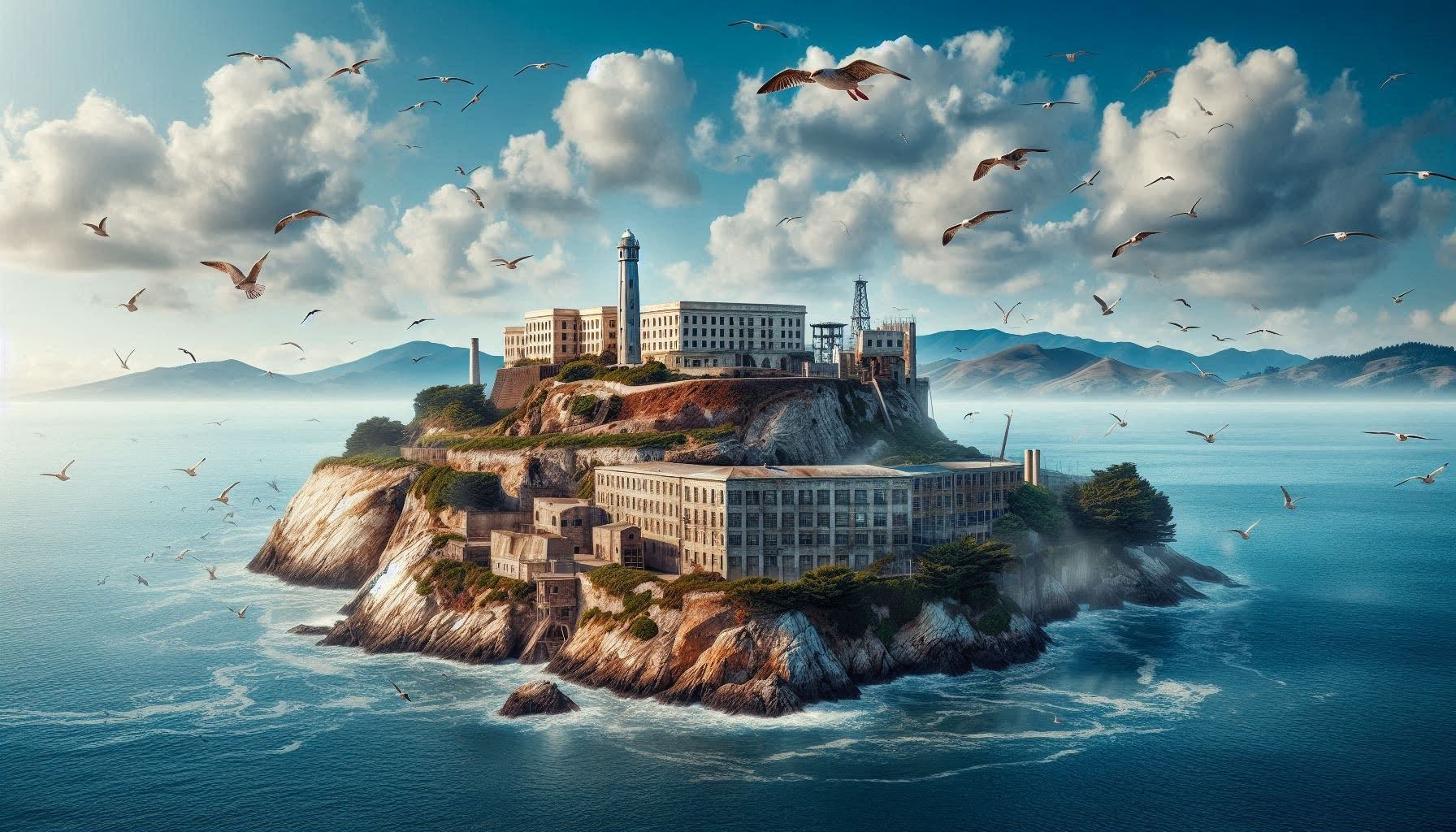
Over 60 years later, the daring 1962 breakout of Frank Morris and the Anglin brothers remains the only escape from the Rock that may actually have worked.
WASHINGTON, DC
Alcatraz was built to break the imagination before it broke the prisoner, and that is one reason the 1962 escape still feels so alive in American memory, because the men who slipped out of the most feared federal prison in the country did not merely run from a cellblock; they challenged the central myth of the Rock itself.
For decades, Alcatraz had been sold as the end of the line, the place where the federal government sent men who had already proven too violent, too manipulative, or too escape-minded for ordinary confinement. Surrounded by freezing water, rough currents, gun towers, and a reputation engineered as carefully as its steel, the island was supposed to make the very idea of escape feel ridiculous.
Yet on the night of June 11, 1962, Frank Morris and brothers John and Clarence Anglin made that ridiculous idea look possible, and more than sixty years later, their disappearance remains the one Alcatraz story the government never truly managed to close.
The facts that matter most are still remarkably crisp. The men carved escape routes through the walls of their cells using improvised tools. They disguised their absence with dummy heads made from plaster, paint, and real hair. They climbed into an unguarded service corridor, reached the roof, descended to the shoreline, and launched an improvised raft stitched together from raincoats. By morning, they were gone.
The FBI still tells the story that way in its official history of the Alcatraz escape, and the Bureau still frames the case with the contradiction that keeps it alive, namely that nearly all of Alcatraz’s escape attempts ended with recapture or death, while the fate of these three men remains unresolved.
The breakout worked because the prison’s routine became part of the plan.
One reason the escape still commands respect even from people who believe the men drowned is that the planning itself was extraordinary.
Morris, who had a long history of prison escapes and a reputation for being unusually intelligent, shared adjoining cells with the Anglin brothers in B Block. Over months, they used stolen spoons, a vacuum motor, and other improvised tools to widen the ventilation openings at the back of their cells. They masked the work with cardboard and paint. Above them, hidden from ordinary view, was a utility corridor that gave them the one thing a prison like Alcatraz was never supposed to grant, a layer of infrastructure the guards were not watching closely enough.
The plan depended not just on courage but on patience, because every stage required them to exploit boredom, noise, and human habit. Alcatraz guards expected discipline to produce predictability, and the men turned that predictability back against the institution. Night checks became something to be fooled. Cell walls became something to be worked on slowly. A musical instrument became something to be repurposed as a tool. Even sleep itself became camouflage once the dummy heads were placed in the bunks.
That is what still makes the story feel so sharp. It was not a lucky sprint. It was a patient mechanical answer to a prison built on routine.
The Rock’s reputation is what made the disappearance so powerful.
If the same breakout had happened from a less famous prison, it would still be admired as a feat of planning. What made it legendary was the setting.
Alcatraz was not merely another penitentiary. It was the prison the government used when it wanted to send a message. It held Al Capone, George “Machine Gun” Kelly, and other inmates whose names had already become part of American criminal folklore. It was isolated, expensive, and punishing by design.
The Bureau of Prisons still notes in its short history of Alcatraz that 36 men were involved in 14 separate escape attempts during the prison’s federal years, with most either caught, shot, or confirmed drowned. That official record matters because it explains the phrase that has followed Morris and the Anglins for generations. They were not merely escapees. They were the men who may have been the only ones to beat the Rock.
That word, may, is doing a lot of work.
Because the great unresolved question is not whether they got out of the prison. They did.
The question is whether they got out of the Bay.
The government’s answer has long been drowning, but the evidence never quite forced that ending.
The FBI closed its active case in 1979 after concluding that Morris and the Anglins most likely drowned in the cold waters of San Francisco Bay while trying to reach shore. From a purely official standpoint, that remains the government’s strongest historical position.
There were serious reasons for it. The water was brutally cold. The currents were dangerous and time-sensitive. The men were traveling at night on a homemade raft built from raincoats. Debris linked to the breakout, including a paddle, a wallet wrapped in plastic, and part of a flotation device, turned up in the Bay, which helped support the theory that the raft had failed and the men had succumbed to the elements.
The official logic is not irrational. It is sober, physical, and in many ways persuasive.
But what it never had was the one thing the public instinctively wants from a story like this, finality.
No bodies were recovered.
No confirmed death scene was found.
No fully persuasive forensic event forced the country to stop imagining that the three men had paddled or drifted into one of the darkest and most improbable survival stories in American criminal history.
That absence is the whole mystery.
The evidence that kept the case alive was always small, strange, and just credible enough.
The Alcatraz escape would have faded into prison folklore long ago if every lead after 1962 had been obviously absurd. But the case survived because some later evidence was difficult to dismiss completely.
Families of the Anglin brothers insisted for years that the men survived. Stories surfaced about Christmas cards, quiet phone calls, and indirect messages. A photograph reportedly showing two men believed to be the Anglins in Brazil kept the family theory alive even though law enforcement never confirmed it. Then, in 2018, public attention exploded again when authorities revealed a letter received years earlier claiming to be from John Anglin.
The letter said all three men had survived the escape, that Frank Morris died in 2008, that Clarence Anglin died in 2011, and that the writer wanted medical treatment in exchange for surrender. Investigators tested the letter, but the results were inconclusive. It was not enough to solve the case, yet it was strong enough to keep the case from settling back into official certainty.
That is part of why the U.S. Marshals never let go. The FBI closed its active file, but the Marshals kept the warrants alive and the search open in the unlikely event the trio was still alive. In 2022, more than sixty years after the breakout, authorities even released new age-progressed images, a sign that the government still regarded the case as unresolved enough to warrant public attention. People captured that renewed fascination in their look at the case sixty-two years later, noting that the men had never been found, dead or alive.
That detail matters because it reveals the case’s true status. It is not an ordinary unsolved homicide. It is an unresolved disappearance built on one of the most famous prison breaks in the country, where the official answer and the surviving possibilities have never fully defeated each other.
What made the breakout plausible was not luck, but the Bay itself.
For years, one of the biggest arguments against survival was simple common sense. The water around Alcatraz is frigid, the currents are strong, and the island was supposed to sit beyond the practical reach of men improvising escape equipment under pressure.
But later work complicated that certainty.
Ocean-current modeling, independent reconstructions, and public experiments suggested that survival may have been more plausible than earlier generations believed, especially if the men entered the water or launched at precisely the right moment in the tide cycle. The point is not that those later efforts proved the trio survived. They did not. The point is that they weakened the old certainty that survival was physically impossible.
That mattered enormously for the legend.
Once the Bay stopped looking like a certain death sentence and started looking like a narrow, terrifying possibility, the case changed shape. The men were no longer just vanished prisoners, likely lost to the water. They became candidates for the greatest successful prison escape in federal history.
And that possibility, however thin, was enough to keep the public imagination from ever closing the file.
The case survived because it touches something larger than crime.
D.B. Cooper survives because he stepped out of an airplane and out of ordinary law. Jimmy Hoffa survives because power may have erased him. Morris and the Anglins survive because they attacked the idea of total confinement itself.
That is why the Alcatraz breakout still feels bigger than a prison story.
It asks whether any cage is truly absolute.
It asks whether the state can ever honestly say a human being is fully contained.
It asks whether a legend becomes stronger when the official version is probable but not proven.
The setting intensifies all of that. Alcatraz sits in full public view in San Francisco Bay, visible, photographed, tourable, and endlessly narrated. It is a prison everyone can see, which makes the unsolved escape feel even more provocative. The country can look directly at the Rock and still not know what became of the men who left it.
That same collision between confinement, disappearance, and long-tail uncertainty is one reason readers interested in escapes, fugitive strategy, and the limits of state control often end up in broader modern discussions at Amicus International Consulting and in its analysis of cross-border extradition and long-horizon fugitive risk, where the deeper issue is rarely just whether someone ran, but whether time, geography, and identity eventually turned pursuit into myth.
The escape’s lasting power comes from what it denied the FBI.
The FBI investigated the case for seventeen years and came away with a conclusion, but not a capture.
That distinction is everything.
The Bureau could explain the breakout. It could reconstruct the tools, the route, the timing, the raft, the false heads, and the debris. What it could not do was produce the men. That failure, even if the men died within hours of leaving the island, was enough to give the escape a special place in American criminal history.
Frank Morris and the Anglin brothers denied the federal government the visual ending it needed. They were never marched back in handcuffs. They were never photographed after recapture. They never sat across from investigators to explain how much of the plan had really worked.
Instead, they passed out of the prison, into the Bay, and then into that narrow band of uncertainty where legends are made.
That is why the phrase “successful escape” still needs quotation marks, even now.
They unquestionably escaped Alcatraz.
They may have escaped the water.
And because no one ever proved otherwise, they remain the men the FBI could not catch.
More than sixty years later, that may be the real power of the case. Not that it was solved by drowning or solved by survival, but that it resisted being solved cleanly at all. The Rock kept its myth of punishment. The escapees kept their myth of possibility. And somewhere between the prison walls and the dark tide beyond them, America got one of its last great fugitive mysteries.